

































































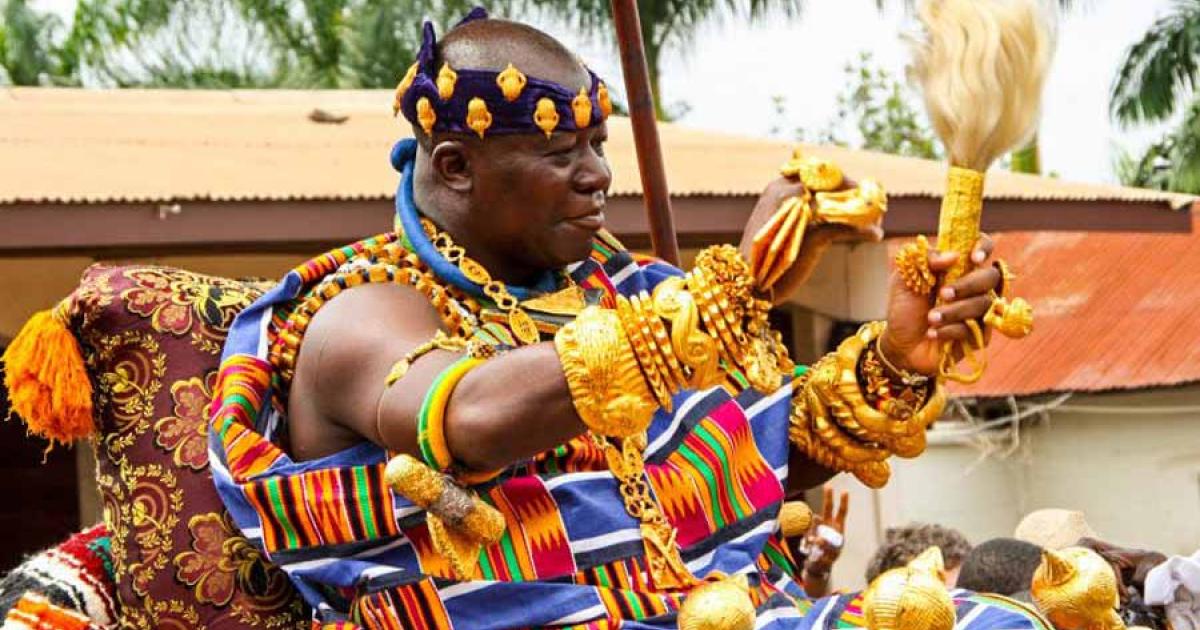
The Ashanti (Asante) Kingdom is one of West Africa’s most powerful and enduring precolonial states. Centered in present-day Kumasi, the kingdom rose to prominence in the early 18th century and continues to play an important cultural and political role in modern Ghana.
According to GhanaRegions.com, this article explores the origins of the Ashanti Kingdom, a comprehensive list of its kings (Asantehenes), and how the kingdom evolved into its present-day status.
Origins of the Ashanti Kingdom
The Ashanti Kingdom was formally established around 1701 under the leadership of Osei Tutu I, with the spiritual and political guidance of Okomfo Anokye. Before unification, the Ashanti people were a collection of Akan-speaking clans.
Osei Tutu I and Okomfo Anokye united these clans into a centralized state and successfully defeated the powerful Denkyira Kingdom. This victory marked the birth of the Ashanti Empire as a dominant regional force.
The Golden Stool: Symbol of Unity
At the heart of Ashanti identity lies the sacred Golden Stool (Sika Dwa Kofi). According to tradition, Okomfo Anokye summoned it from the heavens. It is believed to house the soul of the Ashanti nation and is considered more sacred than the king himself.
No king sits on the Golden Stool—it is a spiritual symbol of unity, authority, and continuity.
List of Kings of the Ashanti Kingdom (Asantehenes)
Below is a historical list of the rulers of the Ashanti Kingdom:
Early Kings and Empire Builders
- Osei Tutu I (c. 1701–1717)
Founder of the Ashanti Kingdom and architect of its early expansion. - Opoku Ware I (1717–1750)
Expanded the empire significantly and strengthened central governance. - Kusi Obodom (1750–1764)
Maintained stability during a period of consolidation. - Osei Kwadwo (1764–1777)
Introduced administrative reforms and merit-based leadership.
Period of Expansion and Internal Struggles
- Osei Kwame (1777–1803)
Faced internal challenges but maintained the kingdom’s structure. - Osei Bonsu (1803–1824)
Oversaw peak military power and wealth through trade and conquest.
Era of Anglo-Ashanti Wars
- Osei Yaw Akoto (1824–1834)
Ruled during early conflicts with British forces. - Kwaku Dua I (1834–1867)
Long and relatively peaceful reign focused on diplomacy. - Kofi Karikari (1867–1874)
Lost the capital Kumasi temporarily during British invasion. - Mensah Bonsu (1874–1883)
Attempted to rebuild after defeat. - Prempeh I (1888–1931)
Exiled by the British during colonial expansion.
Colonial Resistance and Annexation
A key figure during this era was Yaa Asantewaa, who led the famous War of the Golden Stool in 1900 against British colonial forces.
Despite fierce resistance, the Ashanti Kingdom was annexed into the British Gold Coast in 1902.
Restoration and Modern Kings
After decades under colonial rule, the Ashanti monarchy was restored in 1935:
- Prempeh II (1931–1970)
Oversaw cultural revival and modernization. - Opoku Ware II (1970–1999)
Strengthened traditional governance within modern Ghana. - Otumfuo Osei Tutu II (1999–present)
Current Asantehene, widely respected for promoting education, peace, and development.
Economy, Culture, and Military Strength
The Ashanti Kingdom thrived economically through:
- Gold mining and trade (earning the region the name “Gold Coast”)
- Ivory and kola nut trade
- Agriculture and craftsmanship
Culturally, the Ashanti are renowned for:
- Kente cloth weaving
- Skilled goldsmithing
- Festivals such as Akwasidae, celebrating ancestors and heritage
Militarily, the Ashanti built a highly disciplined army and used European firearms acquired through trade, enabling them to dominate much of present-day Ghana.
Conflict with Britain and Colonial Rule
Throughout the 19th century, the Ashanti fought multiple wars with the British, known as the Anglo-Ashanti Wars. These conflicts lasted nearly 70 years and ultimately led to:
- The exile of King Prempeh I
- The 1900 War of the Golden Stool
- Formal annexation into the British Gold Coast in 1902
The Ashanti Kingdom in Modern Ghana
Today, the Ashanti Kingdom exists as a traditional authority within Ghana. While it no longer holds political sovereignty, it plays a significant role in:
- Cultural preservation
- Regional leadership
- Social development initiatives
The current king, Otumfuo Osei Tutu II, is a highly influential figure both nationally and internationally.
Visiting the Ashanti Region
Visitors to Kumasi and the Ashanti Region can experience:
- The Manhyia Palace Museum
- Traditional festivals like Akwasidae
- Kente weaving villages
- Historic sites tied to the Ashanti Empire
The Ashanti Kingdom remains one of Africa’s most remarkable historical civilizations. From its founding by Osei Tutu I and Okomfo Anokye to its modern-day role in Ghana, the kingdom has demonstrated resilience, cultural richness, and enduring influence.
Its legacy lives on not only through its kings but also through its traditions, symbols like the Golden Stool, and the vibrant identity of the Ashanti people today.