


























































Poland is facing a major constitutional and political crisis following an escalating confrontation between Prime Minister Donald Tusk’s pro-European government and conservative President Karol Nawrocki over the leadership and legitimacy of the country’s Constitutional Tribunal.
According to GhanaRegions.com reporters, the crisis intensified on October 30, 2026, after Tribunal judge Anna Korwin-Piotrowska announced the suspension of Tribunal President Bogdan Święczkowski and his deputy, Bartłomiej Sochański, for one month.
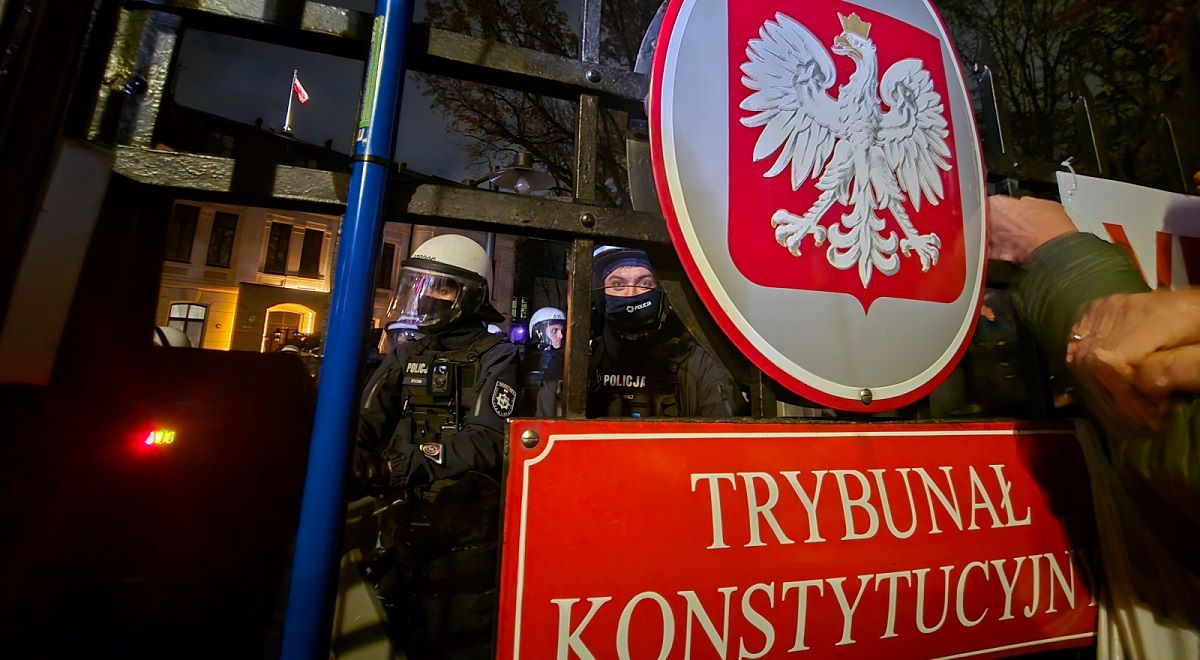
She subsequently assumed responsibility for managing the institution, triggering protests, police deployment and accusations of an illegal takeover.
President Nawrocki, an ally of the nationalist Law and Justice (PiS) opposition, cut short his official visit to Senegal and returned to Warsaw, accusing the government of attempting to seize control of one of Poland’s most important constitutional institutions.
What Happened at Poland’s Constitutional Tribunal?
The latest confrontation centres on disagreements over judicial appointments and who has the legal authority to control the Constitutional Tribunal.
Korwin-Piotrowska announced the suspension of Święczkowski and Sochański, arguing that their actions had obstructed the court’s operations and prevented newly elected judges from performing their duties.
The suspended leadership rejected the decision, questioning its legality and refusing to recognise the authority of the newly appointed judges.
Justice Minister Waldemar Żurek also moved to seek the removal of their legal immunity, potentially opening the way for criminal investigations.
Meanwhile, hundreds of protesters and opposition politicians gathered outside the Tribunal in Warsaw. Clashes occurred as demonstrators confronted security forces, with police making several arrests.
President Nawrocki Intervenes as Political Tensions Escalate
President Karol Nawrocki became directly involved in the confrontation after cutting short his trip to Senegal and returning to Poland.
He visited the Constitutional Tribunal building, challenged the actions of the government-backed judges and described the developments as an illegal takeover of a constitutional institution.
Nawrocki subsequently called for urgent consultations with representatives of parliamentary political parties to address the growing crisis.
The president’s intervention further intensified the dispute between the presidency and Tusk’s government.
Background: Poland’s Decade-Long Judicial Crisis
The current confrontation dates back to 2015, when disagreements between the Civic Platform (PO) and Law and Justice (PiS) parties over judicial appointments triggered a prolonged dispute about the independence of Poland’s judiciary.
The controversy intensified during PiS’s eight years in government between 2015 and 2023, when judicial reforms attracted criticism from European institutions.
Since becoming prime minister in 2023, Donald Tusk’s government has promised to restore judicial independence and address concerns about the rule of law.
However, President Nawrocki and opposition politicians argue that the government’s latest actions undermine constitutional procedures and threaten the independence of the courts.
European institutions, including the European Court of Human Rights and the Court of Justice of the European Union, have also raised concerns about aspects of Poland’s judicial system.
What Happens Next?
The immediate challenge is determining who has the legal authority to lead the Constitutional Tribunal and whether the disputed judicial appointments and suspensions are valid.
The confrontation could further weaken public confidence in Poland’s judiciary, deepen political divisions and complicate the government’s efforts to restore relations with European institutions.
The Tribunal’s internal dispute is also expected to remain a major political issue as both sides continue defending their interpretations of the Polish Constitution.
Poland’s Constitutional Tribunal crisis has therefore become a wider battle over judicial independence, constitutional authority and the separation of powers, with significant implications for the country’s democratic institutions.